Browsing Category "ARTICLES"

Browsing "Older Posts"


TO CLEAR PAPER JAM IN HP PRINTER M1319f

HOW TO CLEAR PAPER JAM IN HP PRINTER M1319f

By Muhammad Meer → Monday, April 27, 2015

1.      MY HOBBY
Every one has his own hobby so I have my hobby is to write essays and compose poems although it is not considered as a hobby but to me it is just like a hobby it provides me an opportunity to read a lot of books magazines and newspapers. In my leisure time, I study different books to get knowledge for my essays. Essay writing is really a difficult task because an essay writer should have knowledge of science, commerce and arts. For this purpose, I have lots of books. My poetry is in my mother-tongue. I always try to inscribe the message of god in my poetry. I get peace of mind by writing essays and composing poetry. My hobby but also worship to God and the best ways of passing my leisure time.

2.      CRICKET MATCH
I had a chance to see a cricket match played between Indiaand Pakistan. I reached the ground about half an hour before the match started. Pakistani team won the toss and began to play at 9:00 a.m. the first player was out for 10 runs and the second for twelve runs then, the captain went in who scored 20 runs hence, and all team was for 109. The players of Indian team were good batsman. Pakistani team fielded well. They scored 140 runs. Pakistan team decided to play well in the second innings. MudassarNazar and Mohsin Khan played very well. Both the players looked aggressive against Indian bowling and made a lot of runs. Pakistan team was out for 200 runs Indian team lost encouragement and their victory in the first innings turned their heads, and so Pakistanwon the match.

3.      MY BEST FRIEND
Nadeem is my best friend. He is tall and slim. He comes of goods and noble family. His father is a doctor while mother is a lecturer. Nadeem has four siblings. He is the youngest of all. He is very intelligent and hardworking. He always tops the class. I also work hard to go ahead of him. But I always stand second still I like him very much because his friendship shown me a way to the better future. I have a library of my father in my house where we both study together. He is my next - door neighbour. We go to the playground in the evening to play cricket. We don�t quarrel to one another because we mutual understanding between us. I feel proud of him and him of me.

4.      A HOCKEY MATCH
Last month a match was played between Imran club, Mirpurkhas and Nadeem club, Hyderabad in the ground of Hammed pura colony, Mirpurkhas. Both the teams reached according to schedule time. I was also there to see the match. Before the match started, the teams were introduced with the chief guest. There was a large crowd the people around the ground. The match started exact at 11 o�clock in the morning. Imran club tried hard to press Nadeem club but their bitter opposition did not let them succeed to score any goals. After interval, Nadeem club made fierce attack but Imran club could not defend in the right way and lost encouragement. Suddenly the captain of Nadeem club up the ball straight to the striking circle and succeeded to score a goal. This one goal encouraged them so much so that they scored 20 goals in successions and won the match. The people, who came from Hyderabad, shouted loudly with joy.

5.      MY AIM IN THE LIFE
Everyone has his own purpose of the life so I have some prefer to be doctors while some to be lecturers or engineers but the purpose of my life is quite different form all of them I want to be neither a doctor nor an engineer but the servant of the people. Whether become a doctor or some-thing else, but I will keep on helping the needy and poor persons. Life is god given so I will try my best to pass my best to pass my life in accordance with commandments of the Holy Quran and the teaching of our Holy Prophet (P.B.U.H). The purpose of life should not be to run after wealth or to give harms. Some people try hard to get more and more wealth but even they get nothing. We must look to the rights of the neighbours, the relatives, the windows, the handicapped persons and friends. Serving the country should also be our purpose because our country is just like our mother; therefore, the responsibility lies upon us to defend our mother. In the last, I just say if I become and Mujahideens and Army men. If I become a teacher, I will leaves no stone unturned to bring forth creative min personalities and if I become a shopkeeper, I shall never give a short measure.

     �GOD MAY SUCCEED ME IN MY LIFE�

6.      THE CAMEL
The camel is a huge animal. It has a hump on its back which makes the camel ugly. It has clumsy legs with soft pads under its feet, a longneck and a small tail. It is called �SHIP OF DESERT� because it stores a lot of water in its stomach (Hump). In old days the people used it to travel and carry their good from one place to another it can travel nearly 30 km a day. Even today it is used by farmers who carry cotton from villages to cities. It is also used in ploughing and drawing water from the wells in the villages. It lives on grass, hay, leaves of tree. The children are very afraid when they see the camel.                                                                       

7.      COMPUTER
The computer is the modern invention of 20th century it has a brain like human-being which works faster than the human-being. It is used in the Offices, Banks, Factories and a lot of places. No sector of life is left where computer has not stepped on it has created great easiness in human life. Side by side it has created some problems like unemployment, destruction of Islamic values. When there was not computer many people did calculating in the Banks. But today one person with the help of computer does the same work all alone. The young boys and girls keep on chatting all the day on internet which has created such problems looking to be irreparable. The computer consist of many parts, but the Monitor, CPU, Keyboard, Mouse are the top of list. The CPU stand for Central Processing Unit. It is called brain of the computer and saves all information which we provide it. Monitor is just like T.V in size. It display the information which we give to keyboard is used for operating computer. It has various buttons like the manual type writer.

8.      MY COUNTRY
The homeland is just like mother. The person who does not love his country is just like a murderer of his mother. Having gone through the history we come to know that many men & women have given the noble sacrifices for motherland. Pakistan is my country. It was established on 14th August 1947 by the special efforts of Quaid-e-Azam Muhammad Ali Jinnah and other prominent leader of all India Muslim league our forefathers sacrificed properties live and sanctities of daughters sisters, wives and brothers to get this piece of land. My homeland meets my basic amenities as my mother looks to my little wishes. My country has given me full protection to my life and properties as much as I feel protection in the lap of my mother. My country is very beautiful. It has valleys, Rivers and mountains. I run from the East to the West and the North to the South and enjoy the natural things what are for me. There are four provinces in Pakistan. Each province is full of natural resources.

9.      THE COW
The cow is the most useful domestic animal it is found almost all over the world. It has four legs, tow pointed harm and a tall most of the cows have whites and brown colour. It gives milk which is useful to us in different ways. We get butter, cream; ghee and curd form its milk. Its skin is used for making boots, shoes and combs we sacrifice cow on Eid-ul-azha and eat its meets with keen internet because it is very testy. Its dug is used as a fuel in the village. The cow is considered to be very innocent. For Hindus, the cow is just like their gods and goddesses because the worship the cow. Long and short, the cow is very useful for us in different ways.

10.  THE FARMER
The farmer is an important figure of the society it is because that we get vegetable, wheat, and the different things at our doorsteps. The farmer gets up early in the morning and drives his cattle to the fields and works under the scorching sun all the day. He leads a very simply life and does not know more about the city life. He is fully happy and contented with what he gets from his fields. He performs prayer regularly. At noonhe sits under a shady tree and takes meal there. He takes rest for a while. The farmer is considered just like backbone in the society.

11.  THE SCHOOL POEN
School poem is the lowest worker of the school who work manually. He gets very little salary (Money) for this great serves he comes early in the morning this duty is to unlock all the classrooms and clean the desk and the chair. He also doing and carry the other required things from out of the school. He does not get much respect from the teachers and influential student. He is very sensor to student and teachers and tried to obey the all orders of teacher and students.


12.  ALLAMA MUHAMMADIQBAL
Allama Iqbal is our national poet. He gives the idea of an independent Muslim state in the south Asia. He was born at Sialkotin 9th November 1877. He got his early education there. After this he went to Lahoreand passed his M.A in philosophy. He served as professor at government college Lahore then proceeded to England on his return from there he began practice as a lawyer but he did not like this job. He was interested in poetry and national problems. He was worried about Muslims. He expressed his falling in his poetry and prose. So he started writing poem. Some of his famous books are: �Bang-e-Dara, Zarb-e-Kali, Asrar-e-Khudai, Asrar-e-Bekhudi, Bal-e-Jabrail and Zaboor-e-Ajam�. It was Allama Iqbalwho first demanded for a separated state for the Muslim. In Allahabad meeting he plainly said in his presidential address, �That Hindus and Muslims are two separated nations they cannot flourish under the same rule� he put his idea before Muslim league and Quaid-e-Azam realized his demand. Every verse of Iqbal is full of sprit of life. Dr. Allama Iqbal died in Lahore on the 21stApril 1938 at the age of 61. His dream of separated homeland for the Muslims could not be fulfilled in his life time.

13.  SHAH ABDULLATIF BHATTI
Shah Abdul latif was born in a small village called hala Haveli in 1689. In those days, Sindh was a great area of learning so they settled. While Abdul Latifwas only a boy, he began to compose poetry. He was very fond of acquiring knowledge. He loved God and his creation. As he grew up, he becomes a great scholar of Persian and Arabic. He was married when he was twenty years old. Day by day, Shah Abdul latif become very popular among the people for his poetry. When his father died, he shifted to a mound of sand at some distance from the village. Now the people began to gather round him. The follower of shah called him �SHAH ABDUL LATIF BHATTI�. Here he always prayed to the God. Some time he composed verses in his praise he found pleasure only in the devotion prayer and deep thinking. Shah Abdullatif was a poet of the people and wrote poetry in the language of the farmer and favour. He was not only a saint and poet but also a musician. In those days music was very popular in Sindh. So Shah AbdulLatif began to take great interest in music and become a great singer. Later on he made many changes in music to make it simple and easy. He also invented a simple musical instrument, which is called �TAMBOORA�. His �Urs� is held on the 14th Safar. Every year form far and wide comes to celebrate the �Urs� of Shah Abdul.

14.  THE POSTMAN
The postman is a public servant. He is very useful to society he delivered mail, money, order invitations and parcels to us. He wears a khaki uniform. He carries a bag across his shoulder. He keeps all the letters and parcels inside it. He can read English, Hindi, etc. he gets up very early in the morning. At first he goes to the post-offices. After collecting letters from there he delivers those letters to us. He goes door to door and delivers the mail. He brings happy news as well as sad news. He undertakes daily two rounds in his area. Whether it rains or it is very hot he does works regularly and he is very punctual. Every day we wait for him. He brings news of our relatives and friends. He is honest. His work is very hard. We should be thankful to him for working so hard for us.

15.  MY BEST TEACHER
I am lucky to have a good teacher in my school; Mr. Muhammad Hussain is my teacher. He teaches us English Grammar. He is a young looking very active person. He is a master of the best personality all the student respect him for his personality. And good behaviour and love with them. All other teacher teaches us by punishment but he teacher with love he does not take the help of punishment. The student always find him co-operative and ready for help our other teacher do not went to meet with their students outside the class room but he always invites his student to seek guidance from him. He arranges various competitions and debates to make the student ready for undertaking great jobs sometimes he brings the head master of our school to watch the competition and gives awards and prizes For the encouragement of the student his sole aim is to create intelligent and smart student from his class who many lead a successful life in their practical life. Due to efforts we have a great number of officers from our school. Inspite of his good nature and hard work he has not been liked by his other colleagues who awant him not to give lift to his students. But he is very popular among the students of our school.


16.  QUAID-E-AZAM MUHAMMAD ALIJINNAH
Quaid-e-Azam Muhammad Ali Jinnah was born in Karachion 25th December 1876. He received his early education in Sindh in Madarssat-ul-Islam Karachi after passing his matriculation examination he went to England for acquiring higher education. In Englandhe took part in various gatherings arranged by some Indian personalities. He got a bar at law degree from England. He started practice first Karachi and then Bombay. He was offered a job by British government, but he refused to accept the same. His aim and ambitions was to serve his people. He joined the Indian National Congress and tried to solve the problems faced by the Indian Muslims, but when he could not succeed then he joined Muslim League. It was the result of his efforts that he Lucknow pact was signed by the leaders of Hindus and Muslims. Quaid-e-Azam was struggle for Pakistan and he succeeds in his Mission.

17.  A PICNIC
Last Friday some of my friend decided to have a picnic at Kotri Barrage. We carried lunchboxes, a bag of fruit and water cooler. It was cloudy. We hired a taxi and reached at the barrage at 9.00a.m. We got down from the taxi in the front of �All-Manzar�; we kept our lunchboxes and other things in the hotel. We walked around the barrage and amused our selves. One of our friends Nasir wanted to swim in the canal but we did not let him do so. We gave some money to a boatman and sailed across the river for something. At about 1.00 o�clock we returned to Al-Manzar, we sat in the lawn and had lunch. One of our friend bought friend fish. The fish was very delicious. Everyone liked it. After lunch we little rest. Our friend basher, who is very found of singing, He entertained us with his sweet voice, at about 4.00 p.m; we got up and looked tea. We did fully justice to everything. We returned home happily every one of us enjoyed the outing.

18.  A JOURNEY BY TRAIN / RAILWAY JOURNEY
During the last summer vacation, I went to Kashmir. I traveled by train my mother. We packed our luggage. We hired an auto- rickshaw. We reached the railway station. We bought ticket and then returned to the plate form. There was a big crowd of people waiting for the train. Some people were standing and some were sitting on the benches. The train arrived. We entered our compartment. We had comfortable seats near the windows. There were people of different cities, state and area in the train. Some passengers were polite and some were rude. Some were talkative and other was quite. The train started I also started looking out the window. Green field looked very beautiful. After six hours we eat dinner at hotel near the station then we again got in the train. The small engine ran on the narrow tracks. I enjoyed the scenery of green hills on the either side of the railway line. We also passed through the dark tunnel. The journey to Kashmir was very pleasant.

19.  THE POSTMAN
The postman is a public servant. He is very useful to society he delivered mail, money, order invitations and parcels to us. He wears a khaki uniform. He carries a bag across his shoulder. He keeps all the letters and parcels inside it. He can read English, Hindi, etc. he gets up very early in the morning. At first he goes to the post-offices. After collecting letters from there he delivers those letters to us. He goes door to door and delivers the mail. He brings happy news as well as sad news. He undertakes daily two rounds in his area. Whether it rains or it is very hot he does works regularly and he is very punctual. Every day we wait for him. He brings news of our relatives and friends. He is honest. His work is very hard. We should be thankful to him for working so hard for us.

20.  FOOTBALL MATCH
Today games are become an important part of our life. They promote good Health. Last Sunday my father took me to see a football match. It was played at National Stadium at India Gate. We reached the Stadium on our martin car. We parked the car in the parking and bought two tickets and then returned the Stadium. The match was between our football team and a visiting England team. The stadium was full of capacity. Our captain won the toss. It will prove an existing match. The England team�s player started to kick the ball hard. Our players put up a strong defence. Before the interval they scored an equalizer. In the beginning the match was slow, but later it become very interesting. The match began again after the interval. The Englandteam�s player started to kick the ball hard. Our player put up strong defence. Both teams tried hard but our teams scored a goal and won by one goal.

21.  THE POLICEMAN
The policemen are an important public servant he is strong tall and a healthy man. He is a government servant. He wears a small khaki Paint and Malaishia shirt. He kept a small stick in his hand. He plays a very important role. He has to do a lot of work. He goes place to place to catch thieves and bad people. Bad people create a lot of trouble for of us bad people afraid of him. A policeman has to work and night. At night he goes on the round of the area. A police helps good and peace-loving citizen. He helps them to be happy. Some policemen are trained to control crowds. We must always cooperate with the in him maintained law and order situation. We should respect him. Our life and property are safe because of the policeman.

ENGLISH ESSAYS

By Muhammad Meer → Friday, April 3, 2015

A language is defined as the medium of expression of thoughts . All the human beings in this world communicate with each other by a language. Similarly, computer also needs some expression medium to communicate with others
A computer follows the instructions given by the programmer to perform a specific job. To perform a particular task, programmer prepares a sequence of instructions, know as programmed. A program written for a computer is known as Software. The programmed is stored in RAM. The CPU takes one instruction of the programmed at a time from RAM and executes it. The instructions are executed one by one in sequence and finally produce the desired result.
The Journey of computer software machine language to high level languages to modern 4GL / 5GL languages is an interesting one. Let us talk about this in detail.

FIRST GENERATION LANGUAGES 1GLs (Machine language)

When the human being stared programming the computer the instruction were given to it in a language that it could easily understand. And that language was machine language. The binary language a language, a language of Is and Os is known as Machine language. Any instruction in this language is given in the form of string of 1s and 0s. Where the symbol I stand for the presence of electrical pulse and 0 stands for the absence of electric pulse. A set of 1s and 0s as 11101101 has a specific meaning to a computer even through it appears as binary number to us.
The writing of programmer in machine language is very cumbersome and complicated and this was accomplished by experts only. All the instructions and input data are fed to the computer in numeric form, specifically a binary form.

SECOND GENERATION LANGUAGES 2GLs (Assembly Language)

Lots of efforts are made during last 50 years to obviate the difficulties faced for using the machine language. The first language similar to English was developed in 1950 which was known as Assembly Language or Symbolic Programming Languages. After 1960, the High Level Languages were developed which bought the common man very to the computer. And this was the main reason for tremendous growth in computer industry. The high level languages are also known as Procedure Oriented Languages.

THIRD GENERATION LANGUAGES (3GLs ) (High Level Languages)

The assembly language was easier to use compared with machine la language as it relieved the programmer from a burden of remembering the operation � codes and addresses of memory location. Even though the assembly languages proved to be great help to the programmer, a search was continued for still better languages nearer to the conventional English language. The languages developed which were nearer to the English language, for the use of writing the programmer in 1960 were known as High Level languages.
The different high level languages which can be used by the common user are FORTRAN, COBOL, BASIC, PASCAL, PL-1 and many others. Each high level language was developed to fulfill some basic requirements for particular type of problems. But further developments are made in each language to widen its utility for different purposes.

FOURTH GENERATION LANGUAGES (4GLs)

The 3GLs are procedural in nature i.e., HOW of the problem get coded i.e., the procedures require the knowledge of how the problem will be solved . Contrary to them, 4GLs are non procedural. That is only WHAT of the problem is coded i.e., only �What is required� is to be specified and rest gets done on its own.
Thus a big program of a 3GLs may get replaced by a single statement of a 4GLs. The main aim of 4GLs is to be cut down on developed and maintenance time and making it easier for users.

GUI BASED LANGUAGES

With the invention and popularity of GUI based interfaces. GUI based languages include:
  1. TCL/Tk
  2. Visual basic
  3. Visual C++
  4. C# (Pronounced as C sharp)
  5. Visual basic.NET
  6. Visual basic 2005

LANGUAGES OF COMPUTER

By Muhammad Meer →
COMPUTER
Computer is an advanced electronic device that takes raw data as input from the user and processes it under the control of set of instructions (called program), gives the result (output), and saves it for the future use.
This Computer Fundamentals tutorial covers a foundational understanding of computer hardware, software, operating systems, peripherals etc. along with how to get the most value and impact from computer technology.

Generation of Computer


Generation in computer terminology is a change in technology a computer is/was being used. Initially, the generation term was used to distinguish between varying hardware technologies. But nowadays, generation includes both hardware and software, which together make up an entire computer system. There are totally five computer generations known till date. Each generation has been discussed in detail along with their time period and characteristics. Here approximate dates against each generations have been mentioned which are normally accepted.

Following are the main five generations of computers

First Generation (1940-1956) Vacuum Tubes:


The period of first generation was 1946-1959. The computers of first generation used vacuum tubes as the basic components for memory and circuitry for CPU (Central Processing Unit). These tubes, like electric bulbs, produced a lot of heat and were prone to frequent fusing of the installations, therefore, were very expensive and could be afforded only by very large organisations. In this generation mainly batch processing operating system were used. Punched cards, paper tape, and magnetic tape were used as input and output devices. The computers in this generation used machine code as programming language.


The main features of first generation are:

Vacuum tube technology

Unreliable
Supported machine language only
Very costly
Generated lot of heat
Slow input and output devices
Huge size
Need of A.C.
Non-portable
Consumed lot of electricity

Some computers of this generation were:


ENIAC

EDVAC
UNIVAC
IBM-701
IBM-650

Second Generation (1956-1963) Transistors:


Transistors replaced vacuum tubes and ushered in the second generation of computers. The transistor was invented in 1947 but did not see widespread use in computers until the late 1950s. The transistor was far superior to the vacuum tube, allowing computers to become smaller, faster, cheaper, more energy-efficient and more reliable than their first-generation predecessors. Though the transistor still generated a great deal of heat that subjected the computer to damage, it was a vast improvement over the vacuum tube. Second-generation computers still relied on punched cards for input and printouts for output.


Second-generation computers moved from cryptic binary machine language to symbolic, or assembly, languages, which allowed programmers to specify instructions in words. High-level programming languages were also being developed at this time, such as early versions of COBOL and FORTRAN. These were also the first computers that stored their instructions in their memory, which moved from a magnetic drum to magnetic core technology.

The first computers of this generation were developed for the atomic energy industry.

The main features of second generation are:


Use of transistors

Reliable in comparison to first generation computers
Smaller size as compared to first generation computers
Generated less heat as compared to first generation computers
Consumed less electricity as compared to first generation computers
Faster than first generation computers
Still very costly
A.C. needed
Supported machine and assembly languages

Some computers of this generation were:


IBM 1620

IBM 7094
CDC 1604
CDC 3600
UNI VAC 1108

Third Generation (1964-1971) Integrated Circuits:


The development of the integrated circuit was the hallmark of the third generation of computers. Transistors were miniaturized and placed on silicon chips, called semiconductors, which drastically increased the speed and efficiency of computers.


Instead of punched cards and printouts, users interacted with third generation computers through keyboards and monitors and interfaced with an operating system, which allowed the device to run many different applications at one time with a central program that monitored the memory. Computers for the first time became accessible to a mass audience because they were smaller and cheaper than their predecessors.

The main features of third generation are:


IC used

More reliable in comparison to previous two generations
Smaller size
Generated less heat
Faster
Lesser maintenance
Still costly
A.C needed
Consumed lesser electricity
Supported high-level language

Some computers of this generation were:


IBM-360 series

Honeywell-6000 series
PDP(Personal Data Processor)
IBM-370/168
TDC-316

Fourth Generation (1971-Present) Microprocessors:


The period of fourth generation was 1971-1980. The computers of fourth generation used Very Large Scale Integrated (VLSI) circuits. VLSI circuits having about 5000 transistors and other circuit elements and their associated circuits on a single chip made it possible to have microcomputers of fourth generation. Fourth generation computers became more powerful, compact, reliable, and affordable. As a result, it gave rise to personal computer (PC) revolution. In this generation time sharing, real time, networks, distributed operating system were used. All the high-level languages like C, C++, DBASE etc., were used in this generation.


The main features of fourth generation are:

VLSI technology used

Very cheap
Portable and reliable
Use of PC's
Very small size
Pipeline processing
No A.C. needed
Concept of internet was introduced
Great developments in the fields of networks
Computers became easily available

Some computers of this generation were:


DEC 10

STAR 1000
PDP 11
CRAY-1(Super Computer)
CRAY-X-MP(Super Computer)

Fifth Generation (Present and Beyond) Artificial Intelligence:


The period of fifth generation is 1980-till date. In the fifth generation, the VLSI technology became ULSI (Ultra Large Scale Integration) technology, resulting in the production of microprocessor chips having ten million electronic components. This generation is based on parallel processing hardware and AI (Artificial Intelligence) software. AI is an emerging branch in computer science, which interprets means and method of making computers think like human beings. All the high-level languages like C and C++, Java, .Net etc., are used in this generation.


AI includes:

Robotics

Neural Networks
Game Playing
Development of expert systems to make decisions in real life situations.
Natural language understanding and generation.
Fifth Generation

The main features of fifth generation are:


ULSI technology

Development of true artificial intelligence
Development of Natural language processing
Advancement in Parallel Processing
Advancement in Superconductor technology
More user friendly interfaces with multimedia features
Availability of very powerful and compact computers at cheaper rates

Some computer types of this generation are:


Desktop

Laptop
NoteBook
UltraBook
ChromeBook

GENERATION OF COMPUTER

By Muhammad Meer →


INTRODUCTION:
A pn - junction diode is an electronic device formed from a p-type and an n-type substance semiconductor. A semiconductor diode has the property of one way conduction i.e. it allows electric current to flow in only one direction.

FABRICATION OF pn-JUNCTION:
A pn-junction is fabricated by placing a small amount of indium on a plate or wafer of n -type germanium. Indium on heating at 550oC melts and diffuses through a small part of the n-type germanium. Indium being a p-type impurity, converts the part of the n-type germanium to p-type material. Thus a junction is formed between p-type section and an n-type section of germanium.
A brass-base is used to fix the pn-junction to which leads are attached as shown:
The whole apparatus is sealed in a glass tube or a metallic tube.

WORKING OF pn-JUNCTION DIODE:
As we know that a p-type substance has excess of mobile positive charge or holes and n-type substance has an excess of negative charge or electrons, the electrons from n-type and holes from p-type sections flow across the junction and combine. In this way a layer of positive charges is formed on the n-type and a layer of negative charges on p-type material. Due to induction of these layers a potential barrier is now developed across the junction and further flow of charges is prevented from one side to the other.

PN-JUNCTION DIODE OR SEMICONDUCTOR DIODE

By Muhammad Meer →
GALVANOMETER:
Galvanometer is an electromagnetically instrument which is used for the detection of electric currents through a circuit. Being a sensitive instrument, Galvanometer cannot be used for the measurement of heavy currents.

WORKING PRINCIPLE:
Galvanometer works on the principle of conversion of electrical energy into mechanical energy. When a current flows in a magnetic field it experiences a magnetic torque. If it is free to rotate under a controlling torque, it rotates through an angle proportional to the current flowing through it.

ESSENTIAL PARTS OF GALVANOMETER:
There are five essential parts of a Galvanometer.
    1. A U-shaped permanent magnet with concave poles.
    2. Flat rectangular coil of thin enameled insulated wire C?.
    3. A soft iron cylinder 'B'.
    4. A pointer or needle.
    5. A scale.
CONSTRUCTION:
The flat rectangular coil of thin enameled insulated wire of suitable number of turns wound on a light nonmetallic or aluminum frame is suspended between the cylindrical concave poles of magnet by a thin phosphor bronze strip. One end of the wire of the coil is soldered to strip. The other end of the strip fixed to the frame of the galvanometer and connected to an external terminal. It serves as one leas current lead through which the current enters or leaves the coil. The other end of the wire of the coil is soldered to a loose and soft spiral of wire connected to another external terminal. The soft spiral of a wire serves as the other current lead. A soft-iron cylinder, coaxial with the pole pieces, is placed within the frame of the coil and is fixed to the body of the galvanometer. In the space between it and the pole  pieces, where the coil moves freely, the soft iron cylinder makes the magnetic field stronger and radial such that into whatever position the coil rotates, the magnetic field is always parallel to its plane.

WORKING:
When a current passes through the galvanometer coil, it experiences a magnetic deflecting torque, which tends to rotate it from its rest position. As the coil rotates it produces a twist in the suspension strip. The twist in the strip produces an electric restoring torque. The coil rotates until the elastic restoring torque due to the strip does not equal and cancels the deflecting magnetic torque, then it attains equilibrium and stops rotating any furthers.

MOVING COIL GALVANOMETER

By Muhammad Meer →

Some of you will want to start building a generator right away, while others will want to study some of the many interesting things about electricity and magnetism.  If you have all of your generator materials, you're ready to go!  If you need materials, click here.  For a more complete lesson on electricity and magnetism, you might like to check out this webpage first (not yet ready).   Click here to start an MPEG video that shows the generator in action.  Or click here  to see a QuickTime video about Hoover Dam (the picture above) from WWW.Teachers Domain.org that is a segment of a larger video from WGBH Boston Public Television.  You must have QuickTime installed to see this video because the video has a "captions on/off" button that we cannot translate to an MPEG file.


Here is our generator. It consists of a pair of magnets on an axle, and a coil of wire wound onto a U-shaped core of iron-like material called Soft Ferrite (click here to learn about Ferrite). The Ferrite core is positioned so that the magnets spin between the legs of the "U". The ends of the wire coil are connected to a small light bulb.  You can spin the axle by hand or by winding a string around the spool and giving it a pull.

An Instructor's Note (that kids can read, too!) 
The simple motor designs that you will find on the web can often be made with the simplest of materials in an assembly that can be so fragile that the slightest mishandling can break it.  This is not acceptable in the design for a generator.  To obtain a generator voltage output that is usable, the generator armature must be spun rather rapidly, so this structure must be designed so that it can handle some abuse.  Further, to obtain sufficient output voltage, whatever coil is used for inducing a current must have many turns, usually several hundred. Therefore, the physical structure for holding the coil must also be able to tolerate the physical manipulation required for the winding of a lot of wire.  So this means that a little extra expense in time and materials spent to construct a robust, rigid frame can make a lot of difference in obtaining satisfying results. There are generator designs on the web that rely on the use of heavy cardboard for the basic structure around which a wire coil is wound, or that use a simple nail for the armature that may hold an assembly of spinning magnets.  They are a great academic exercise for the experienced adult, but are difficult to assemble for a third or fourth grader.  The design we present requires additional work in preparation, but we think that both instructors and students will find the end results much more satisfying.

Assembly


1. Assemble the axle. 
Start with the threaded rod and install a nut and washer as in this picture. The washer and nuts that you use are shown at the top.  Use the ruler to see how close the nut should be from the end of the threaded rod; leave about 1/4" of threaded rod sticking past the nut on the right. Tighten the nuts onto the axle with a small wrench.


2.  Attach magnets to the axle.  
Start with two magnets attached end-to-end.  Now pull the magnets apart without changing which magnet ends are closest, and place the axle in between the two magnets as shown in the picture.  We've put some dots on the magnets to keep track of the ends of the magnets.


3.  Finish the armature. 
The assembly consisting of the magnets and axle is called an armature.  Place another washer onto the axle and add another nut.  Again, use a pair of small wrenches to tighten the nuts so that the magnets do not fall off.

Finally.
add the two 1/4" diameter spacers as in the picture below; the arrows point to the spacers.  It helps to add a tiny bit of glue (like Deco cement or hot glue) to the nuts before you screw on the spacers so that the spacers do not come off easily.  These spacers will serve as bearings within the wooden frame, so make sure that the outsides of the spacers are smooth and free of glue.

 4.  Assemble the frame. 
Start with the frame piece with the two large holes.  Add the four 1 1/4" screws as shown in the picture.  Put the short end of the axle into the hole in the middle of the frame. 

 Now slide the four nylon spacers onto the screws.
Slide the other frame piece onto the screws and axle.  If the armature is too tight and does not turn freely, you might need to use some fine sandpaper to smooth out the center hole in the frames.
 Now add the nuts onto the four screws and tighten the nuts.  Check to see that the armature turns smoothly.
  
5.  Attach the spool.  First put a nut and washer onto the axle like this.

Now add the spool, another washer and a nut.  The hole in the spool is too large, so you will need to move the spool from side to side to center the spool on the axle.  This way, it will not wobble when you turn the armature.  When the spool is centered, tighten the last nut.


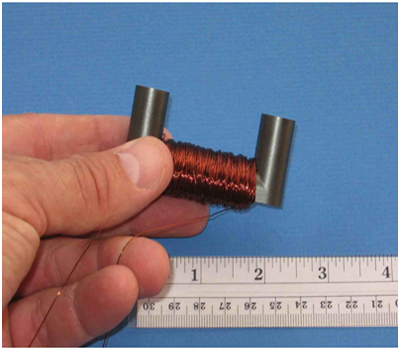
6.  Wind the core.  You'll want to wind about 800 turns of magnet wire around the base of the U-core (whew!).  Don't worry, it doesn't take too long!
Be very careful not to drop the core on the floor!  Ferrite is brittle (like a ceramic cup) and can break if you drop it.  It can be epoxies back together, but then you'd have to wait for the epoxy to cure while everyone else is making their generator, so be careful! Start by taking about 6" of wire from your roll of wire, and wrap it around a leg of the U-core (on the left side above my thumb).  This way, it will be available for connection to a light bulb after the winding is finished.  Use a piece of tape to secure this end temporarily in place. 

Now keep going and wind, wind, wind, wind until you count 800 turns.   Wind the wire so that it is forms a layer of uniform thickness, not just a big blob of wire in the middle of the core.  When you have finished winding the core, leave an additional 6" of wire remaining at the end of the winding (see the extra wire wrapped around my fingers).
Put a piece of tape around the whole winding to keep it from coming apart.
7.  Assemble the frame and coil. 
Put the coil into the large holes in the frame.  Temporarily put a pair of 1/4" diameter spacers or pieces of dowel under the coil (see the arrows in the picture below).  See how there is a little space between the end of the armature shaft and the coil of wire?  Ice cream sticks also work as spacers.

Add some hot glue to the ends of the core to hold it in place onto the frame.  When the glue has cooled, remove the temporary spacers.

8.  Strip off the insulation. 
The magnet wire is coated with a tough insulation that is like varnish.  You will need to scrape off this insulation on the end of the magnet wire so that you can make a good electrical connection to your light bulb.  One way to do this is to use a piece of sandpaper.  Fold the sandpaper in half and squeeze it around the end of the wire.  Pull the wire through the sandpaper.  Move the sandpaper around so that you take off the insulation all around the wire.  The bare copper will be bright and shiny, so it is easy to tell when the insulation has been removed. Your teacher is probably handy with a pair of scissors and might know another way to scrape off the insulation!

9.  Connect the light bulb. 
The last task is to connect the light bulb to the coil of wire.  Take one bare end of the magnet wire and twist it around one bare end of the light bulb wire.  Do this again with the other bare end of the light bulb wire.  Make sure that the two bare ends of the light bulb wire are not touching.  Then tape the bulb to the side of your generator so that you can easily see the bulb when you operate the generator.
  
10.  Make some electricity!  Wind a length of string tightly around the spool.  Hold the motor down onto a table with one hand.  Make sure that your hand does not interfere with the rotation of the armature with your other hand, pull the string firmly so that the armature spins around quickly.  Your light bulb will light as the electric current that you generate passes through the light bulb.

 Materials

1. Small bar magnets. Neodymium-Iron-Boron magnets, part number B448, from K&J Magnets $0.82 each in quantities of 10, $0.69 each in quantities of 100.

2. Roll of #30 Magnet Wire, 150 feet. This wire is ordinary copper wire that has been coated with a thin insulating coating made from enamel. The wire is specifically made for winding onto a form, often called a "core". Eventually, we'll need to scrape off some of the insulating coating on the ends of the wire to make electrical connections.  Magnet wire (unlike other forms of insulated wire) is sold by weight, not by length.  A pound of #30 magnet wire is over 3000 feet and usually the smallest amount of magnet wire that one can purchase as a standard is 1/4 pound, so we have contracted with a supplier to provide spools wound with 200 feet each for individual projects.


3. Ferrite core. The magnet wire is wound around the "U"-shaped Ferrite core (Adams Magnetic Products, Ferro cube UR64/29/14-3C81, Adams part #1000382, @ 2.50 each in small quantities). The magnets will spin between the arms of the "U". Each time the magnets rotate one-half turn, the magnetic field within the "U"-shaped core changes directions. A burst of electric current will be induced in the coil of wire wound around the core each time this happens.


4. Plywood Frame. These are the parts that hold the whole generator together, and require the most work to fabricate. They should be made from a good grade of thin 1/8" plywood.  You'll need an electric drill or even a drill press to fabricate these two parts accurately so that all the holes line up. Perhaps someone in your school district has a wood shop where these parts can be fabricated. It is pretty important to do a good job of making these parts to make sure that the magnets spin freely and securely between the sides of the frame.  If the two plywood sheets are first cut to size, and then are taped securely together, the holes may be drilled through both sheets simultaneously.  This reduces alignment problems.

 One way to make the frame is to tape this layout to your pieces of plywood, and use it to accurately position your drill.  When you print the form, you'll need to make sure that your printer has properly scaled the size of the pattern. Simply measure the pattern and compare the actual size with the printed dimensions.


5.  Small light bulb.  When the generator armature is spun quickly, the generator will produce an output of several volts.  But small hands may have a hard time getting lots of speed, so we've selected a small incandescent bulb that requires only 1.5 volts.  Also, we'll need a bulb that does not require too much current.  Some theory for you accomplished electrical types: we don't want a bulb with a resistance less than the electrical resistance of the coil of wire wound around the U-shaped ferrite core, which will be about 10 ohms.  Therefore, we would like a light bulb that will illuminate brightly with a current much less than 1.5 volts / 10 ohms = 0.15 Amps.  A very nice choice for the bulb is the Radio Shack #272-1139, rated at 1.5 volts / 0.025 Amps, at about $1.29.  Another excellent bulb is the Miniatronics #10-001-10  rated at 1.5 volts/0.015 Amps, at about $1.08 each per 10 pieces.

A less-expensive alternative is to use a typical light-emitting-diode, such as Dig key #*******.  However, I find these very unsatisfying as a demonstration of the generation of electrical power.  When a 4th graders asks "Why does the LED light up?", are you going to tell them that "the electric field produced by the generator forces an electron from the N-type material, across the P-N junction, into the P-type material where it recombines with a hole, emitting the band-gap energy as a photon" or when the 4th grader asks "Why does the light bulb light up?", will you simply say that "The electrons passing through the thin wire in the light bulb bumps into the atoms and makes the wire so hot that it glows."
  

6. Pile of Mechanical Parts

Here are the remaining mechanical parts needed to complete the assembly.  We suggest purchasing these parts in multiples of 10 sets so as to dramatically reduce the cost per student.  We have selected parts fabricated to the American system of units (inches), rather than metric parts, since well-stocked hardware stores in the US will have these components.

3" length of #6-32 threaded rod.
10 each #6-32 steel nuts.
4 each 3/4" diameter fender washers.
4 each #6 x 5/8" nylon spacers.
4 each #6-32 x 1 1/4" stainless steel machine screws.
2 each 1/4" diameter by 1/4" length aluminum spacers, #6-32 inside thread.
3/4" dia. wooden spoon.
3 feet of string.

Tools for the actual assembly:
5/16" wrench (for the nuts)
screwdriver
1/2" masking tape
hot glue gun

CONSTRUCTION OF SMALL ELECTRIC GENERATOR

By Muhammad Meer → Monday, March 30, 2015